"It's just a kilt."
As a kiltmaker, I've heard that phrase more times than I can count. And I understand why people ask. At first glance, it can seem like a lot of money for one garment.
But here's the thing...
A traditional Scottish kilt isn't just a piece of clothing. It's a handcrafted work of art, made using skills that have been passed down through generations. It's something that, if cared for properly, will outlast most of the clothes you'll ever own. In fact, many kilts are worn by fathers, sons, grandsons and even great-grandsons.
It Starts with the Cloth
Before a kiltmaker even picks up a needle, the tartan has already gone through an incredible journey.
A traditional kilt is made using around eight yards of heavyweight wool tartan (typically 14oz–18oz), woven here in Scotland by some of the world's finest mills. Producing this cloth requires highly specialised machinery, skilled weavers and generations of textile knowledge.
Every metre of tartan represents centuries of Scottish weaving tradition.

The highly specialised craft of weaving tartan on traditional looms.
Every Kilt Begins with Mathematics
Once the cloth reaches the kiltmaker, the real puzzle begins.
One of the first jobs is planning the pleats so that they perfectly match the front apron. Depending on the tartan, this can take anywhere from ten minutes to several hours.
This isn't simply folding fabric.
The aim is to create as many evenly balanced pleats as possible while ensuring the pattern flows beautifully around the entire kilt. Every tartan behaves differently, and every customer has different measurements, meaning no two kilts are exactly alike.

Setting out the pleats so the tartan flows seamlessly around the kilt.
Twenty Hours of Hand Sewing
Unlike mass-produced clothing, a traditional kilt is made almost entirely by hand.
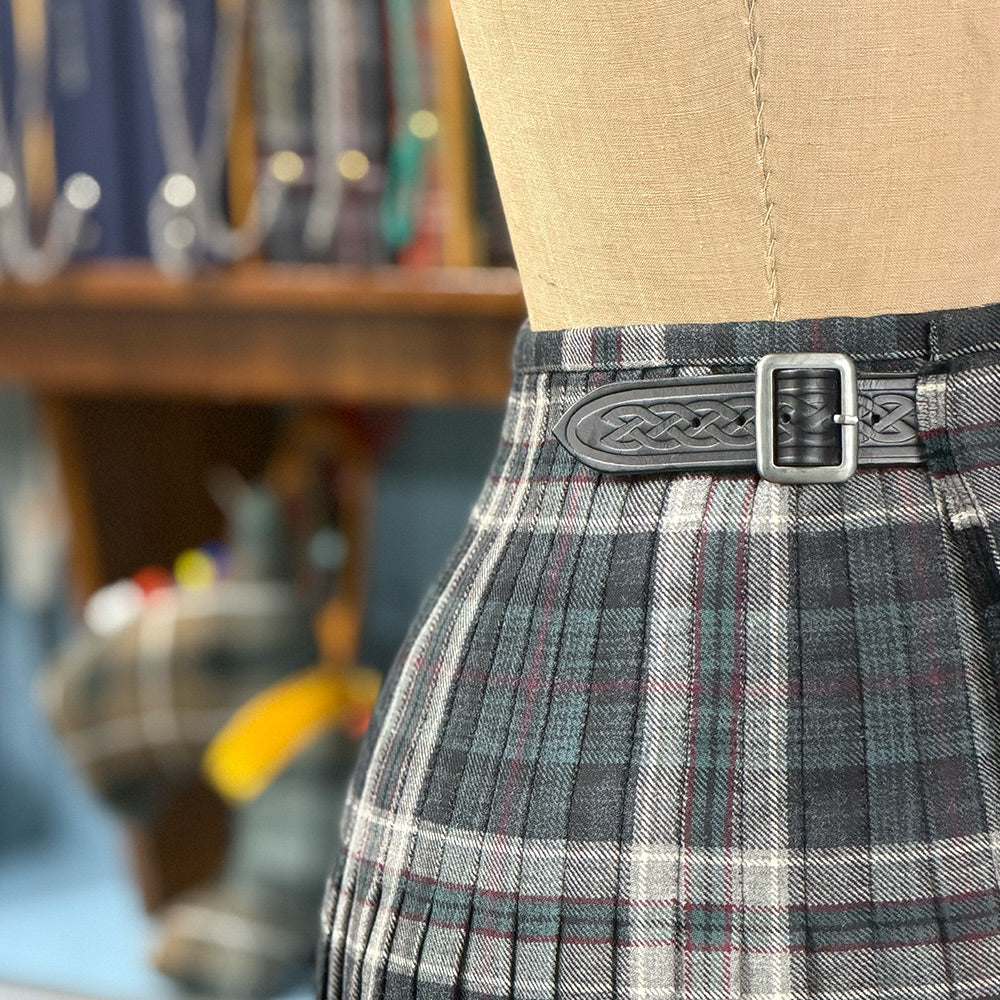
Every stitch helps shape the garment to the wearer's body. The careful hand sewing creates curves across the hips and waist that allow the kilt to sit comfortably while hanging perfectly straight.
A skilled kiltmaker will typically spend between 16 and 20 hours making a single kilt.
Those hours aren't simply sewing—they're years of experience, precision and craftsmanship being stitched into every garment.

The shaping stitches that give a traditional hand-sewn kilt its distinctive fit.
Made to Last a Lifetime... and Beyond
We live in a world of fast fashion.
A £5 T-shirt lasts a season. A cheap pair of trousers might survive a year or two. When they wear out, we simply replace them.
A traditional kilt is the complete opposite.
It is designed to last decades. With proper care, it can be altered as your body changes, repaired if needed, and passed down to future generations. Many of the kilts we see today have already lived several lives.
When you spread the cost over fifty or even one hundred years, it becomes one of the best-value garments you could ever own.
What About the £50 Kilts?

You may have seen "kilts" advertised for £50—or even less.
It's worth asking a few questions.
Where was the fabric woven? Is it genuine Scottish wool? Was it made by a trained kiltmaker? How much could the person making it realistically have been paid?
When you consider that the tartan alone for a traditional kilt costs far more than that, it's clear these garments are something entirely different.
They certainly have a place as novelty items or holiday souvenirs, but they shouldn't be confused with a traditional Scottish kilt.
More Than a Garment
I'm incredibly proud to be a kiltmaker.
Every kilt that leaves my workshop represents around twenty hours of careful craftsmanship, centuries of tradition and a garment that I hope will be worn for generations to come.
So when someone asks me, "Why is a kilt so expensive?", I don't see an expensive garment.
I see Scottish wool woven by skilled craftsmen. I see hours of careful planning and hand stitching. I see a piece of clothing that will still be hanging in someone's wardrobe long after today's fast fashion has been thrown away.
Perhaps the better question isn't, "Why is a kilt so expensive?"
It's "Why has everything else become so disposable?"
Disposable clothing is causing massive environmental damage