
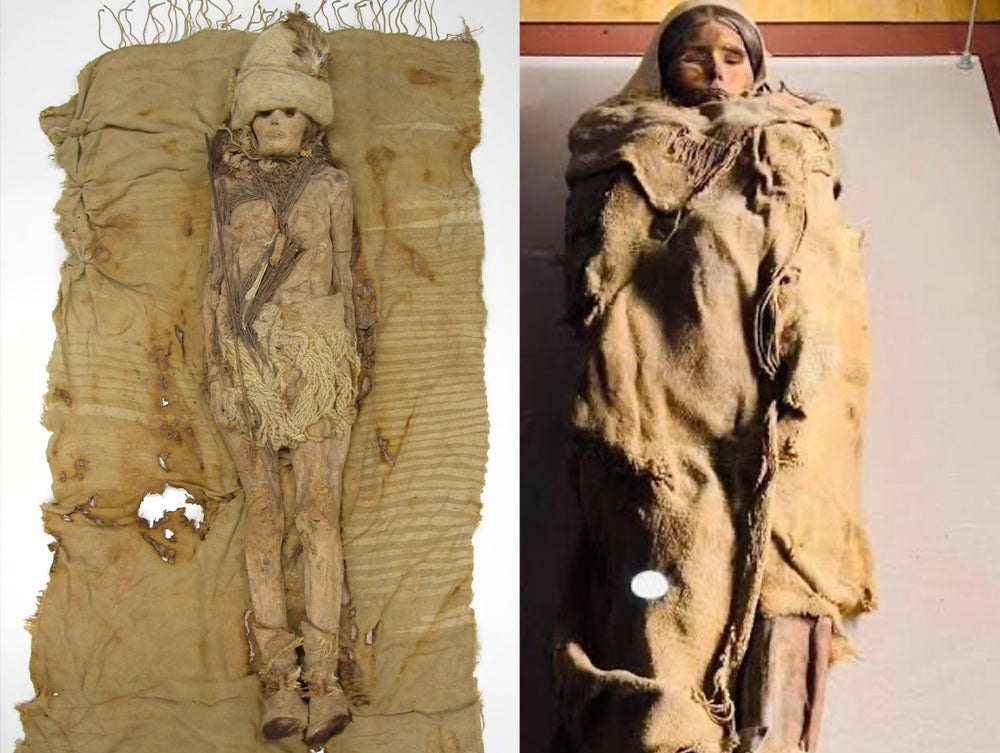
Imagine discovering a perfectly preserved 4,000-year-old mummy wearing what looks remarkably like a tartan kilt. It sounds like something from a Highland legend, but the story begins not in Scotland, but in the deserts of western China.
The Beauty of Xiaohe, one of the famous Tarim Basin mummies discovered in China's Xinjiang region, has captivated archaeologists since her excavation. Thanks to the region's exceptionally dry climate, her body, clothing and even her hair have survived in extraordinary condition.
What has particularly fascinated textile historians is her clothing. She was buried wearing a woollen garment woven in a distinctive twill pattern with coloured stripes. To modern eyes, it bears an unmistakable resemblance to tartan, leading many visitors and journalists to describe it as "kilt-like."
The Tarim Basin mummies have also become well known for their striking physical appearance. Many possess light-coloured or reddish-brown hair and facial features that differ from those typically associated with ancient East Asian populations. Early reports even suggested links to ancient Celtic peoples, fuelling sensational headlines that Scotland's ancestors had somehow reached China.
Modern DNA research, however, tells a different story.
Although the Xiaohe people were genetically distinct and possessed ancestry unlike later East Asian populations, there is no evidence that they were Scottish, Celtic or members of Britain's ancient Caledonii tribe. Instead, they appear to have belonged to an isolated population that developed its own unique culture while maintaining contacts with neighbouring peoples across the Eurasian steppe.
That doesn't make their clothing any less remarkable.
Long before tartan became associated with Scottish clans, twill weaving and checked textiles were already being produced across Europe and Asia. Some of the oldest surviving woven wool textiles, including those from the Tarim Basin, demonstrate that complex weaving techniques had spread widely during the Bronze Age.
For anyone interested in tartan, these discoveries are a fascinating reminder that the story of checked cloth stretches back thousands of years. While the Beauty of Xiaohe was almost certainly not a Scottish Highlander, her beautifully preserved garments show that humanity has appreciated the beauty and practicality of woven patterns for millennia.
Perhaps that's the real story: tartan, or at least the weaving techniques that eventually gave rise to it, belongs to a much older and richer textile tradition than any one nation. Scotland may have perfected tartan into the iconic cloth we know today, but its ancient ancestors were being woven thousands of miles away, four thousand years ago.