
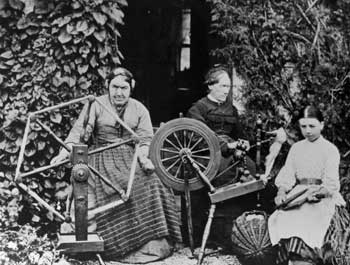
What is weaving - following threads through time
Weaving is one of the primary methods of textile production and put quite simply it involves interlinking a set of vertical threads with a set of horizontal threads.
To understand the practice of weaving and its role in the thriving textile industry, we need to follow the threads of this ancient art all the way back to prehistory.
It is impossible to know exactly when weaving began. Could it have been early man copying nature, we see weaving in bird nests, cobwebs, silk worms.
Early man would have used plants rather than fibres like that of wool.
30,000 year old Flax has been found by archaeologists in a cave at Dzudzuana in the Caucasus sifting through the minutest of soil samples and is the oldest known evidence of man's collection of vegetation for textile production.
 .
.
In Scotland Neolithic Flax working tools have been discovered and carbonised Flax seeds were found at the ‘hall’ at Balbridie, Aberdeenshire, evidence that flax was cultivated from the earliest Neolithic in Scotland (3400 to 4000 BC).

Flax is used for linen, so a fibre still commonly used all around the world. Neolithic man wouldn't have woven linen fabric but more used as a thread.
The first weavings were not used to make clothes. In colder climates people would have obviously used animal skins to stay warm for clothing. The first weaving came with the fisher-gatherer-hunters, weaving of nets. Little to no exact evidence exists but likely to be cords, basketry and nets. Maybe sewing hides together. Cords could have been worn as adornments to the body, this is something we don't know.
Some of the best Neolithic finds (including textiles containing two-ply linen yarn and flax working tools) come from the Swiss lakes. We also see evidence from Israel 23,000 ago where baskets were made from plants.
Other plants such as nettles have excellent fibres for making cord and weaving with.

Stinging Nettles have perfect fibres that can be used.
We can make an educated guess that man would have experimented with thread and string creation, leading into the first textiles. Threads knotted together to make simple things. Finger weaving and basic stick weaving would have been the first way of producing textiles. Nomadic people have continued using finger weaving techniques.

Stick weaving
In Northern Britain, what is Scotland today we have no evidence from this era, 9500 BC Scotland was covered in Ice. The earliest evidence we have of humans living here is around 8000 BC with the discovery of a huge amount (5,000) flint tools in Bigger, North Lanarkshire.
Compare this with the earliest evidence of homo spaiens in Africa which puts 200,000 years ago. New discoveries are always being made. At this time there was also land link between Britain and France.
The earliest settlement from in Scotland was at Crammond, just outside of Edinburgh. This dates from 8500 BC. This was thought to be a hunter-gatherer encampment.
Settlements
Around 6000 BC people began to settle in one place. This was the time of Neolithic Farming. With farming people now had time to make things, experiment and create. This is when we are able to start to piece together more pieces of evidence. We see flax weaving and even evidence of dying.
This was the start of plain weave. The weaver goes over one tensioned thread, and under the next. The following row is the reverse which locks the previous thread in place. This kind of weaving can be seen all over the world from around 8,000 years ago.

Plain Weave
This first kind of loom in Scotland would have been a simple post or backstrap type loom and punched cards of wood that they used to make cloth and straps.
Skara Brae on Orkney
Skara Brae dates back to Neolithic times, over 5,000 years ago. Radiocarbon dating suggests that people were living in Skara Brae for around 650 years between 3180 B.C.E and 2,500 B.C.E, making it older than Stonehenge and the Great Pyramids of Giza. Found on Skara Brae were bone needles for sewing and also bone pins which were used to fasten garments, which points to a strong likelihood go textile being woven. There were also belt fasteners, so evidence of belts being worn.

Imprints on clay of a woven material were found at the Ness of Brodgar, Orkney. This has been dated to 5,000 years ago. The image on the right shows a mould made of the imprint. This is evidence that weaving was definitely present in Neolithic Scotland. This is thought very unlikely to be wool as the neolithic sheep that were introduced had unsuitable wool for weaving, they had a more ‘deer-like coat’ .
We also have evidence from the same time period at Flint How in Dumfries and Galloway. This was also a textile imprint on pottery.
This is evidence of the use of weaving looms. There is no real evidence of that this first type of loom would have been. Maybe a simpler frame which allowed the warp thread to be kept tight while the weft thread was woven in and out with some kind of needle. This would have only made small amounts of cloth.

Elsewhere in the world the loom had also evolved.
Worldwide - In Iran and Egypt a horizontal loom was being used. These looms were used outside.

In colder places. like Scotland, it was horizontal and used indoors. This is when we start to find evidence of the horizontal weighted loom.

Greek women weaving at a vertical warp-weighted loom – Athens, 500s BC
As well and the start of loom weaving in Scotland there was a new fibre to weave with ... wool.
Introduction of Sheep and wool
Sheep are not native to Britain and Northern Europe they were introduced around 3,000 BC when Neolithic man crossed the channel. Archaeological digs of Iron Age settlements show that these ancestral sheep were short-tailed, frequently multi-horned and smaller than modern commercial varieties. It is thought sheep were used for meat and milk rather than their wool for clothing.
Wool survives better than plant fibres so we start to see more archaeological evidence. We can see ancient textiles surviving, preserved in peat bogs or marshes.
Sheep and therefore wool was moved between Persian, Greek and Roman empires. Breeding became selective so their fleece became more useful for weaving. With wool came brighter colours as the fleece took the dye more than the flax and other vegetable fibres.
Pictish/Celtic/Viking times
To the tribes of Northern Britain, textiles would have been powerful symbols of identity and status. With the evolution of the loom to the larger vertically weighted loom more elaborate patterns were starting to happen. Rather than just the plain weave we know see evidence of herringbone and twill.

Twill weave (notice the diagonal stripes)

herringbone pic
In the Pictish period weaving may have been done on either a warp-weighted vertical loom, as practiced in Anglo-Saxon England, or a two-beam vertical loom, exemplified in pre-Viking Ireland, where the warp was stretched between two horizontal beams attached to two uprights, and the weft was beaten downwards so that the cloth was made from the bottom up.
The styles that came with the Celts from Ireland was patchwork,
We know from stone carvings the fashion of clothing was The colours in the drawing to the left of the stone were probably quite true.

Child’s, Pictish woven woollen hood, found intact in a bog in Orkney, 4-6th century AD
Much of what we know about The Picts (a general name given to the tribes by the Romans) came from the Romans. They were names The Picts because they were “The Painted,” or “Tattooed People,”. A blue due that they drew on their bodies with. We have to take a lot of what the Romans said as propaganda to terrify people into not leaving beyond the wall. The blue came from the woad. We can see from the carvings that the 'Picts' were quite conservatively dressed although the Romans said they were mostly naked. The barbarian.
More prosperous Picts were distinguished by their clothing. Wool was now the main fibre used for clothing. Dyes and patterns would have become more and more important.
Celtic patterns we can see in carvings. It would make sense that their clothing would have taken on some of these same symbols. The Celts, Scots came from Ireland bringing their weaving traditions.
With the Romans there was a great movement of people and with this movement skills like weaving would have taken a leap forward. In AD 79, Agricola, the Roman governor of Britannia, sent a fleet to survey and map Scotland’s coast.
Dyes
We can see from evidence across Northern Europe that the main dyes were Madder (red), Weld (bright yellow) and Woad (blue).

Roman's talked of the colours of blues and purples.
This is far from the dull browns we show the first tartans as being on shows like Outlander and Rob Roy.
Introduction of the warp-weighted loom to Scotland.
At some point, the upright warp-weighted loom was introduced into Scotland. This was incresingly common, especially in the Viking era. When we compare textiles in Scandinavia to Scotland they are strikingly similar.

Norse and European
Thorsberg cloak reproduction at the National Museum of Denmark.

Thorsberg cloak reproduction at the National Museum of Denmark from 200 AC.
Vikings had on textile traditions in the Scottish Islands. The earlier Viking period saw far more frequency of use of fabrics with woven patterns including twill weave
Warm Weighted Looms


These combs were made of whalebone. What makes whalebone particularly useful is not only is it strong, dense, and resilient, but it can also be used to produce objects of very large sizes. This collection of weaving combs is from Gurness, Howmae, and Midhowe, Scotland, 2nd century BCE to 4th century CE. (National Museum of Scotland, Edinburgh, UK)

In 1933, during an archaeological dig at Falkirk, an earthenware pot containing Roman coins and two scraps of two-toned woolen fabric was unearthed. The coins dated from between 83BC and 230AD, so it was considered safe to assume that the cloth was from the 3rd century when Falkirk was under Roman occupation. But once again the questions arise. Was tartan design imported into Scotland by the Romans? Or was it already in use by the time they arrived? We can see the Norse had a similar patterns. The herringbone weave . If you look carefully you can see it's quite a complex weave.
Paterned Clothes
Pictish carvings, such as those found on bone at Burray (Fossil & Vintage Centre) on Orkney, the sculptured stones of fighting warriors at Glamis, or the fearsome Rhynie Man, depict male figures in tunics but none of these images suggest that their clothes were patterned.
Handloom Weaving
Handloom weaving was brought to the Irvine Valley by Flemish refugees who settled in the area at the end of the 16th Century.

Flax
flax grown fairly widely across Scotland for hundreds of years. Scotland had a linen export trade to England which grew substantially after 1707. There were initiatives for this.
In contrast at this time traditional coarse wool plaids produced in rural areas by handloom weavers for local use. Quality of product meant that it was not commercially viable for export. England could produce cheaper and better product.
almost all production of woollen cloth in Scotland was for domestic use
---- https://relativelyscottish.com/wp-content/uploads/2021/05/Textile-Industry-Migration-1750-1950.pdf
In 1834 it was reported that in Scotland 800,000 people depended on hand-loom weaving for subsistence. Much of the evidence examined came from Scotland, especially Glasgow and Paisley.The reason for the large numbers employed in the weaving industry was given as the good wages earned after 1780 which, after the introduction of the fly-shuttle, had risen to nearly £100 a year. At this time weavers had risen to high places in society and many had entered the industry hoping those favourable conditions would return. The state of the industry had since been further depressed by the collapse of the Irish linen industry which produced a flood of immigrants into Scotland.
Witnesses all agreed that the numbers entering hand-loom weaving should be reduced and those from Scotland said that where possible weavers were entering the army, emigrating to the colonies or returning to agriculture, but no industries were able to take up the excess labour force.Those examined from Glasgow said that there was full employment but the large numbers meant that all were very poor .
The average day was claimed to be 13 hours, with 6s 5d being earned for a six day week, from which a frame rent of 1s 5d was deducted.It was hoped that a reduction in the number of weavers would mean a reduction in the hours of labour and an increase in the prices paid for their work.
Many were concerned that low wages had caused the splitting up of the family system in which the weavers' children worked with their parents and were educated at home. These children were instead sent to work on the power-looms where they received no education, were beaten and suffered a decline in morals
Hattersley loom
Around 1920, hand looms were replaced by the Hattersley loom
The flying Shuttle
With the introduction of the 'flying shuttle', the weaving industry was revolutionised, and by 1800 power-loom factory workers had taken over from hand-loom
Women's Work
waulking songs

The Sheep
Before the Cheviot and Blackface sheep were introduced to the Islands, the small native tan-faced sheep was shorn for its wool.
Originally weavers worked from home - women and children worked in their own cottages - until the Industrial Revolution when big weaving sheds were set up with power looms. Weavers produced: quality tweeds in the Borders, cottons in the west, damask in Dunfermline, patterned shawls in Paisley and jute in Dundee. Industrial Revolution The poverty of weavers in Scotland according to the 1839 Royal Commission into hand-loom weaving recorded: ‘The great bulk of the regular weavers of Scotland subsist entirely by the loom, and engage in no other pursuits’, domestic weavers worked for 70 hours per week and for wages that were far less than years before…….Their dwellings ‘old, inconvenient and damp’; the furniture in most of the weavers dwellings is ‘scanty and miserable; their beds are often of straw’, a ‘lamentable want of bed-clothing’, their diet a ‘pauper meal’. The Royal Commission Report of 1839 recorded: ‘Owing to poverty, the children of weavers attend school very imperfectly, and are growing up for the most part in a state of ignorance’, concluding that ‘the education of the children is so deficient, that the next generation will grow up in comparative ignorance’. Although officially the Parish would pay for a child whose parents could not afford to, specific instances were recorded of weavers children being forced to stay home because they didn’t have clothes to wear. https://en.wikipedia.org/wiki/Calton_weavers
https://www.scotlandinfo.eu/history-of-cloth-making-and-waulking/
Industralisation

Unknown From the album Gladstone Presentation Album of Scottish Scenery About 1879-1880.
n the middle of the 19th century, the predominant manufactures in Scotland were textiles: cotton, wool, flax (linen) and silk. Scotland's principal imports at that time were raw materials for the cotton and linen mills. In 1838, well over 100,000 people were employed in the textile industry. Factory employment rose from about 60,000 in 1838 to nearly 80,000 by 1856; seventy per cent of these employees were female. In this period, while the cotton industry remained almost static, employing about 35,000 factory workers, the woollen industry doubled in size from 5,100 workers, in 112 factories, in 1838 to 10,200 workers, in 204 factories, in 1856.
Linen had been a major industry in Scotland for hundreds of years; by 1684 an estimated 12,000 people were employed its manufacture. The industry was stimulated by an act of the Scottish Parliament of 1686 stipulating that everyone had to be buried in linen winding sheets made from materials which had been grown, spun and woven in Scotland. Further stimulus came from the act of 1748 prohibiting the importing or wearing of French cambrics, "under severe penalties"; and that of 1751 which allowed weavers to work in all parts of Scotland "free of all corporation dues, conjoined with a bounty of 1 1/2 d. [0.6 pence] per yard on all linens exported at and under 18d [7.5 pence] per yard." Linen had by this time become Scotland's most important export. Although superseded by the cotton industry, in 1838, there were still 17,900 linen factory workers, which had grown to 31,700 by 1856 . There appears to have been substantial consolidation in the industry then however, for the number of factories decreased between 1838 and 1856 from 183 to 163 presumably as a scale effect of the economics of increased mechanisation.
Before the American War of Independence, the tobacco trade had been a major source of wealth in Scotland (contributing largely to Glasgow's growth). Subsequently the Americans could sell freely anywhere, resulting in a substantial decrease in Scotland's trade. This resulted in investment being diverted into cotton, and this industry dominated Scotland's economy for the next hundred years. But the influence of America on Scotland was felt again in the 1860s, when the Civil War cut off supplies of raw cotton and Scotland's cotton industry collapsed. This began Scotland's shift from textiles to heavy industry.
The factory-based textile industries were concentrated into different areas. The cotton industry was based mainly in Lanarkshire and Renfrewshire; from the 1851 census, over 37,000 people in Glasgow were involved directly or indirectly in cotton manufacturing, out of a population of 360,000; a weavers' village was founded in 1705 in the Calton area in the east of Glasgow. Glasgow weavers were involved in several serious industrial and political disputes in the 18th and 19th centuries.
The woollen industry developed mainly in Roxburghshire and Selkirkshire but with significant activity in Perthshire and Stirlingshire; until the late 20th century the Border towns of Galashiels, Hawick, Jedburgh and Selkirk were largely dependent on their woollen mills.
The linen industry was based mainly in Fife and Forfarshire, Dundee becoming its centre, with nearly 50,000 people being employed by 1861 in the city and its surroundings, in mills at at hand-looms. Other areas with significant linen manufacturing were Kincardineshire, Perthshire, and Midlothian.
The silk industry was quite small employing under a thousand people, mainly in Paisley. Paisley's main textile businesses by the middle of the 19th century were the production of its famous shawls and of cotton thread.
In 1838, an estimated 85,000 hand-looms were in use in Scotland: about 50,000 for cottons, in Lanarkshire and Renfrewshire, and about 26,000 for linens, mainly in Fife and Forfarshire. Dunfermline was the centre of "harness" work, such as damask table cloths, napkins, with about 3,000 looms. "Ordinary" linen work - sheets and coarse linens ("dowlas and "osnaburghs") was the staple manufacture, located mainly in Forfarshire (around Dundee). This work employed from 17,000 weavers in summer, to 22,000 or 23,000 in winter, nearly all in small detached buildings adjacent the weavers' cottages. The weaving of tartans - employing about 2,500 looms - was concentrated mainly at Stirling and Aberdeen, was done in the weavers' cottages. But Glasgow had been renowned for its plaids in the early 18th century.
An important act of Parliament of 1833 regulated labour in factories and enforcing care for the education of child-workers. A report in 1853 records that the owners of factories in Scotland "so far from considering their schools a trouble, take the greatest pleasure and pride in showing them; for while they profit by the labours of the children, they do not forget that they have a duty to perform in return, not by carrying out the requirements of the act as if it were intended to be a mere matter of form, but by appointing efficient teachers, furnishing them with the means of imparting the instruction so necessary to the welfare of the children in after-life, and by taking care that it is done." In the larger factories, the adult workers could also participate in the schools.
One might be tempted to cynicism by such a glowing report, and question how many factory owners actually were so caring about their employees. But as early as 1784, David Dale established the New Lanark manufacturing village just outside Lanark, whose inhabitants nearly all worked in the cotton spinning factories there. Dale was deeply concerned about the welfare of his workers and provided a school as well as accommodation.
The table below shows how the numbers of children employed in Scottish textile factories decreased from the 1830s on. But there were still significant numbers of under-13s employed in the second half of the century.
No. of children No. of workers over 13
Year Males Females Males Females Total
1835 2,821 (22%) 3,961 (13%) 12,997 30,401 50,180
1838 918(5%) 944(2%) 17,530 39,920 59,312
1850 585(3%) 779(1.6%) 19,881 45,998 67,243
1856 378(2%) 742(1.4%) 21,762 53,806 76,688
NOTE : : The total numbers employed in textile factories increased by 53 % between 1835 and 1856 . The gender ratio barely changed . In 1835 women represented some 68.35 % of the workforce whilst by 1856 it was 71.13% less than a 3% increase . The number of children ( both boys and girls ) had dropped dramatically from some 13.5% of the workforce in 1835 to less than 1.5% in 1835.
https://thescrubba.com/blogs/news/the-history-of-weaving-and-the-textile-industry
Tongue Twister
‘When a twister, a-twisitng, will twist him a twist
For the twisting his twist he three twines doth intwist;
But if one of the twines of the twist doth untwist,
The twine that untwisteth, untwisteth the twist.”
https://www.arch.cam.ac.uk/research/projects/archived-projects/origins-weaving-project